
A sentence splitter can change a scientific abstract before any sophisticated analysis begins. If it separates a decimal number or leaves two claims joined together, later software may attach a measurement to the wrong finding. The error is easy to miss because the output still looks like readable English. A useful first project in scientific language processing is therefore a small, inspectable sentence-boundary test, built around the punctuation your documents actually contain.
This guide uses invented examples. They are language-processing exercises, not reports of peptide experiments. The aim is to produce sentence spans that a reader can trace back to the original text.
Separate the punctuation mark from its job
A period can close a sentence, mark an abbreviation or sit inside a decimal number. The character is identical, but its role changes with context. A rule that cuts after every period handles a classroom sentence well and fails on ordinary research prose. Capitalization helps, although a chemical symbol or an author’s initial can also begin with a capital letter.
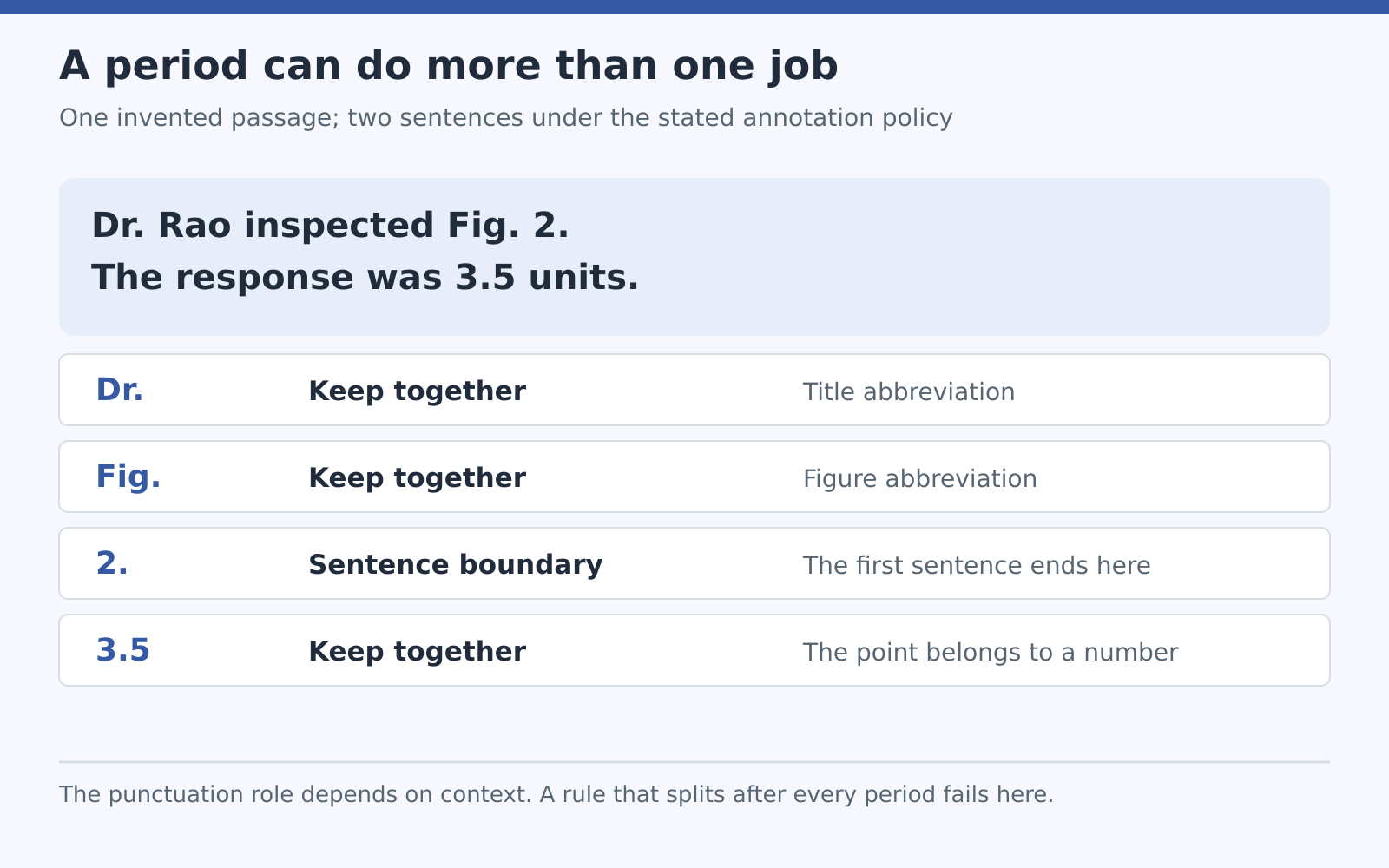
Consider this invented passage: “Dr. Rao inspected Fig. 2. The response was 3.5 units.” A reasonable annotation contains two sentences. The periods after “Dr.” and “Fig.” do not close sentences, and the decimal point belongs to the number. The period after “2” does close the first sentence. A blanket rule protecting every numeral followed by a period would therefore introduce another error.
The Unicode text-segmentation specification describes default boundary rules and explicitly recognizes that punctuation can be ambiguous. It also provides for documented tailoring. That distinction is useful: a default algorithm is a starting point, while a scientific collection may need a clearly recorded local decision.
Write down the boundaries you expect
Start with a compact set of real document types you are allowed to process. Include abstracts, figure captions and references separately if all three matter to the project. Ten clean abstracts cannot represent a collection dominated by scanned bibliographies. Preserve a copy of the original text before correcting whitespace, hyphenation or character encoding.
For each example, record the sentence boundaries as character positions or start-and-end spans. State whether end positions are inclusive or exclusive. Keep the boundary policy short: how headings are handled, whether a list item counts as a sentence, and what happens to an unfinished final line. The policy makes disagreements visible instead of hiding them inside code.
| Invented text fragment | Boundary decision | Reason to test it |
|---|---|---|
| Dr. Rao | No split after Dr. | Title abbreviation |
| 3.5 units | No split inside 3.5 | Decimal number |
| See Fig. 2. Next, compare… | Split after 2. | Abbreviation followed by a real ending |
| e.g. peptide fragments | Keep the phrase together | Multi-period abbreviation |
Include one example in which an abbreviation appears at the end of a sentence and another in which it appears in the middle. This paired test prevents a successful exception from becoming an unconditional rule. Keep examples of extraction artifacts in a separate group so that a language decision is not confused with a broken PDF-to-text conversion.
Have a second reader annotate a small sample without seeing the first answer. A disagreement about a heading is different from a software failure. Resolve the policy first, then compare the splitter with the agreed annotation. This prevents a moving definition of “correct” from making every revision look successful.
Measure false splits and missed splits separately
Suppose an invented test set contains 100 annotated boundaries. Your system predicts 105, of which 95 match the annotation. It has ten false boundary predictions and misses five true boundaries. Boundary precision is 95 divided by 105, about 90.5 percent; recall is 95 divided by 100, or 95 percent. Counting only the total sentences would conceal the difference.
Use exact positions for this exercise. A boundary shifted by one character can reveal a whitespace convention rather than a serious language error, so report that convention alongside the score. If a downstream application tolerates such differences, evaluate that tolerance separately. Do not quietly relax the matching rule after inspecting a disappointing result.
Keep an error sheet with the original passage, predicted split, expected split and error family. “Abbreviation at sentence end” is a more useful label than “bad sentence.” It directs attention to a repeatable problem. A small count table also shows whether one formatting issue accounts for most failures.
Choose a correction that matches the evidence
A short abbreviation list can help with a stable collection, but an abbreviation can occur at a sentence ending too. Protecting every occurrence of “al.” may merge the next sentence after a citation. Examine both sides of the punctuation and test the exception against passages where the same abbreviation really ends a sentence.
Kiss and Strunk’s research on unsupervised multilingual sentence-boundary detection treats abbreviation recognition as a central part of the problem. Their work provides a useful conceptual alternative to viewing every period as an independent stop sign: repeated patterns in a corpus can supply evidence about punctuation roles.
For a practical comparison, run an unchanged baseline and one candidate revision on the same held-out examples. Change one policy at a time. If the revision fixes decimals but damages numbered list items, keep both outcomes in the report. A correction is valuable only for the collection and downstream use it actually improves.
Preserve offsets for later biomedical annotation
Sentence spans often become the containers for gene names, peptide names and relationships. If preprocessing removes characters without retaining a mapping, an annotation offset can point to the wrong word in the source document. Store the original string, the normalized string and a position mapping whenever transformations change length.
For example, replacing a line break with a space preserves length in some files, whereas joining a hyphenated line ending may remove multiple characters. These operations should not be assumed equivalent. Check that slicing the stored source at a reported span returns the text the reviewer expects to see.
The finished record can remain small: input version, boundary policy, software version, test examples and an error summary. Re-run it when the collection changes from general prose to biological abstracts. A reliable sentence boundary does not establish a scientific claim, but it gives later extraction a traceable unit of text to work with.